
Site Content
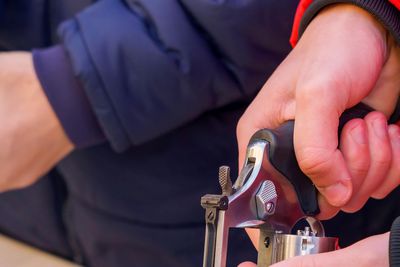
The S&W Revolver
Smith & Wesson (S&W) was founded in 1852 and became one of the most influential revolver makers in the world.
1857: Introduced the Model 1, one of the first commercially successful metallic-cartridge revolvers.
Late 1800s: Developed large-frame revolvers and helped popularize powerful cartridges.
1899: Released the .38 Hand Ejector, ancestor of the modern double-action revolver.
1935: Introduced the .357 Magnum, redefining handgun power.
Mid-1900s: Became the standard revolver for U.S. law enforcement (Models 10, 19, 27, 29).
Modern Era: While semi-autos dominate duty use, S&W revolvers remain popular for defense, hunting, competition, and collecting.
S&W revolvers are known for smooth double-action triggers, strong lockup, and accuracy.
---
Customization & Upgrades
Although revolvers are less modular than semi-autos, S&W models offer meaningful customization.
Grips
Wood, rubber, G10, micarta
Boot grips for concealment
Target grips for range or competition
Trigger & Action
Action polishing (“trigger job”)
Reduced-power springs (balanced for reliability)
Overtravel stops (some models)
Sights
Adjustable rear sights
Fiber-optic or night front sights
Gold bead or patridge blades
Performance & Function
Chamfered or recessed cylinder charge holes (faster reloads)
Moon-clip conversion (on compatible calibers)
Barrel porting (recoil management)
Forcing cone and timing tuning (gunsmith level)
Finish & Appearance
Blued, stainless, nickel
Cerakote or DLC (modern)
Engraving or classic law-enforcement look
Caliber Options
.38 Special / .357 Magnum (most common)
.44 Magnum / .44 Special
.45 Colt / .45 ACP
.22 LR / .22 Magnum (training & competition)
---
Why They Still Matter
Smith & Wesson revolvers are valued for:
Mechanical reliability
Excellent trigger feel
Longevity and collectability
Simplicity under stress
From classic duty guns to tuned competition revolvers or concealed-carry snubbies, S&W revolvers remain timeless tools with enduring appeal.